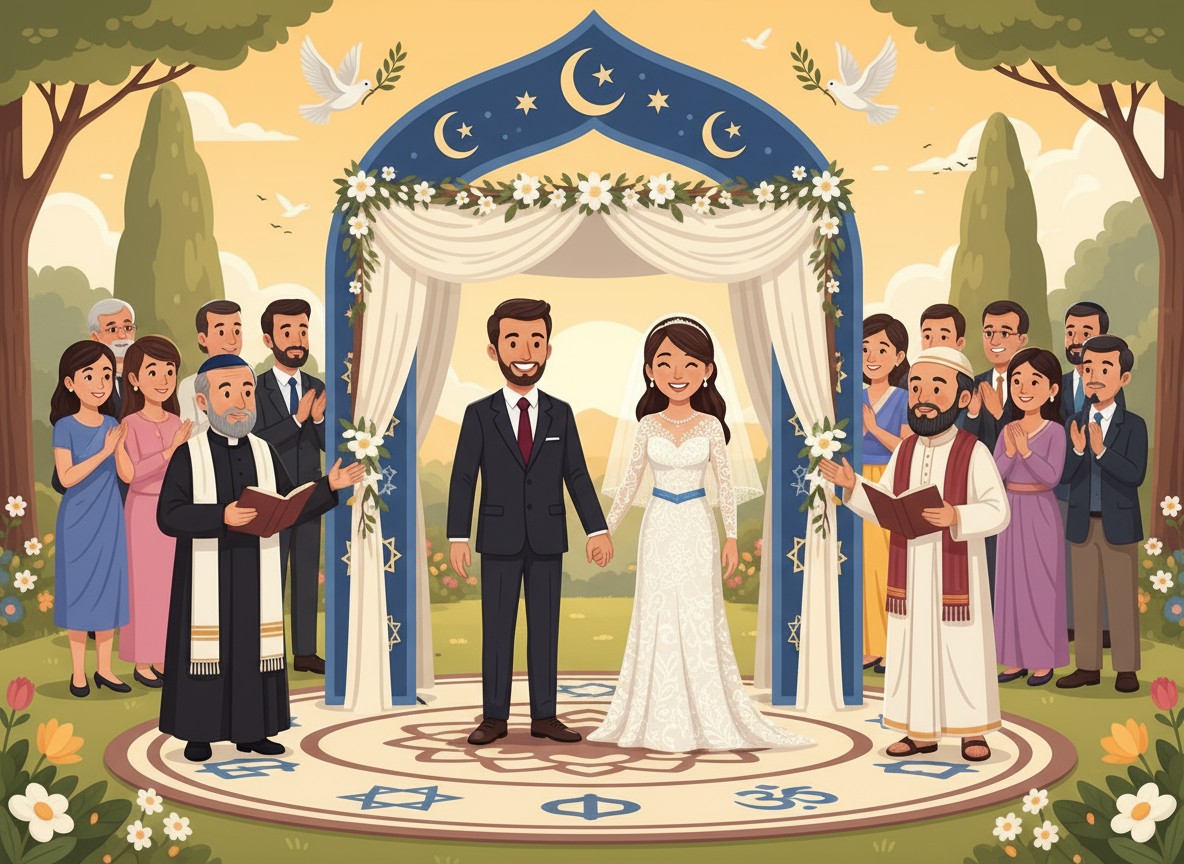
Your Catholic mother envisions you walking down an aisle toward a priest performing Mass. Your partner’s Jewish parents expect a traditional ceremony under a chuppah with a rabbi breaking glass. You both respect your respective traditions but don’t want one faith dominating while the other gets token acknowledgment. This scenario plays out increasingly often as interfaith marriages rise to nearly 40% of all new marriages in the United States. Couples from Christian-Jewish, Hindu-Christian, Muslim-Christian, Buddhist-Jewish, and countless other religious combinations face the complex challenge of designing ceremonies that genuinely honor both traditions without creating awkward hybrids that satisfy no one.
Interfaith wedding planning extends far beyond ceremony logistics—it navigates deeply held family beliefs, cultural identities, and personal values. Religious communities maintain varying degrees of acceptance toward interfaith marriages. Some traditions enthusiastically support interfaith unions while others refuse participation entirely. Family members may react with anything from enthusiastic support to outright rejection. Couples must balance honoring their own spiritual journeys, respecting family expectations, and creating ceremonies that feel authentic rather than performative compromises designed to please everyone while meaning nothing to the actual couple.
This guide examines interfaith ceremony planning from theological, practical, and interpersonal perspectives. You’ll discover strategies for incorporating traditions from multiple faiths, working with religious officials from different denominations, handling family resistance, creating meaningful rituals that honor both backgrounds, and building ceremonies that reflect your actual relationship rather than theoretical religious ideals. The advice here comes from interfaith couples who successfully navigated these challenges, religious officials experienced in interfaith ceremonies, and family therapists specializing in intercultural marriages. Your interfaith wedding can be deeply spiritual, authentically representative of both traditions, and genuinely meaningful—but achieving this balance requires careful planning, clear communication, and sometimes difficult negotiations with families and religious authorities.
Defining What Equal Representation Actually Means
Equal religious representation doesn’t mean identical time allocation or mechanical balance between traditions. A ceremony spending exactly 50% of time on Christian elements and 50% on Jewish rituals might technically be balanced but feel artificial and fragmented. True equality means both partners feel their faith is represented meaningfully and authentically, both families see their traditions honored respectfully, and the ceremony flows naturally rather than feeling like awkwardly spliced segments of different religious services.
Start by discussing what religious representation means to each of you personally. One partner might value having their religious official present more than incorporating specific rituals. Another might care deeply about particular prayers or blessings but feel indifferent about other aspects. Some couples discover they’re both culturally connected to their religions but not spiritually observant, making symbolic gestures more important than theological accuracy. Other couples are deeply religious and need ceremonies that satisfy both their spiritual beliefs and official religious requirements.
Identify non-negotiable elements for each faith tradition. What absolutely must be included for the ceremony to feel legitimate to you, your family, and your religious community? For Catholic ceremonies, this might be specific prayers, sacramental elements, or church setting requirements. For Jewish weddings, it could be the chuppah, ketubah signing, or glass breaking. For Hindu ceremonies, sacred fire and specific mantras might be essential. Once you’ve identified true non-negotiables versus nice-to-have elements, you can design ceremonies incorporating core essentials while being flexible about peripheral details.
The Conversation You Must Have First
Before meeting with religious officials or planning specific ceremonies, have extensive conversations with your partner about your actual relationship with religion. Are you observant practitioners or culturally connected but not actively practicing? Do you plan to raise children in one faith, both faiths, or neither? How important is approval from your respective religious communities versus family satisfaction versus personal authenticity?
These conversations often reveal that ceremony planning conflicts stem from trying to satisfy family expectations rather than honoring your own beliefs. Designing ceremonies that authentically reflect your relationship produces better results than attempting to appease everyone while being true to no one. Your ceremony should represent who you actually are, not who your families wish you were.
Working With Religious Officials From Different Traditions
Finding religious officials willing to participate in interfaith ceremonies requires careful research and clear communication. Many clergy members refuse interfaith ceremonies entirely due to theological objections or denominational policies. Orthodox Jewish rabbis typically won’t officiate interfaith weddings. Traditional Catholic priests require extensive marriage preparation programs and may refuse interfaith ceremonies outside churches. Conservative Muslim imams often decline participation in ceremonies acknowledging other religions as equally valid. However, Reform rabbis, Unitarian Universalist ministers, progressive Christian clergy, and interfaith chaplains frequently embrace interfaith wedding work.
When contacting potential officiants, immediately disclose that you’re planning an interfaith ceremony and want equal representation of both traditions. Ask specific questions about their experience with interfaith ceremonies, their willingness to co-officiate with clergy from other faiths, and whether they have restrictions on incorporating elements from other religions. Some officiants enthusiastically support interfaith couples while others agree reluctantly with significant limitations. You want officiants genuinely supportive of your interfaith union, not those participating grudgingly while expressing disapproval.
Co-officiation by clergy from both religious traditions creates the most balanced approach. Having both a rabbi and a minister, or a priest and an imam, or a Hindu priest and a Christian pastor signals equal commitment to both faiths. However, successful co-officiation requires officiants comfortable sharing authority and willing to collaborate. Schedule meetings with both officiants together to discuss ceremony flow, who speaks when, how to transition between traditions, and how they’ll coordinate during the actual ceremony. Poorly coordinated co-officiation feels disjointed and awkward, while well-planned collaboration creates seamless ceremonies flowing naturally between traditions.
Interfaith Chaplains and Non-Denominational Officiants
Interfaith chaplains specialize in ceremonies bridging religious traditions, bringing training in multiple faith perspectives and experience creating cohesive interfaith ceremonies. These professionals often prove more effective than co-officiating clergy from different denominations who may compete for dominance or struggle to coordinate effectively. Interfaith chaplains can authentically present elements from various traditions without the theological limitations traditional clergy face. However, some families resist interfaith chaplains, viewing them as not “real” religious authorities and preferring traditional clergy from their specific denomination.
Non-denominational ministers and celebrants offer another option, particularly for couples prioritizing personal meaning over official religious validation. These officiants work with you to design completely customized ceremonies incorporating any elements you choose from any traditions. The flexibility is tremendous, but ceremonies may lack the theological depth and authentic religious authority some families expect. Weigh this trade-off carefully—family acceptance versus ceremony customization—based on your priorities and family dynamics.
Specific Strategies for Common Religious Combinations
Christian-Jewish weddings represent the most common interfaith combination in North America and have well-established precedents for blended ceremonies. Many couples combine ceremony elements by having a processional to both Christian music and Jewish music, standing under a chuppah while a minister reads Christian blessings, signing a ketubah alongside Christian marriage certificates, exchanging rings with both Christian vows and Jewish seven blessings, and ending with glass breaking followed by a Christian recessional. Reform and Reconstructionist rabbis often co-officiate with progressive Christian ministers, creating ceremonies that feel cohesive rather than fragmented.
Hindu-Christian ceremonies require more creativity since Hindu wedding rituals are highly structured around sacred fire ceremonies, specific mantras, and multiple elaborate rituals spanning hours. Many couples create two separate ceremony segments—a abbreviated Hindu ceremony with key elements like the saat phere (seven steps around sacred fire) followed by a Christian ceremony with vows, prayers, and pronouncement. Alternatively, some couples hold two completely separate ceremonies on different days, giving each tradition full expression without rushing or condensing. This two-ceremony approach works particularly well when traditions are so different that blending feels forced.
Muslim-Christian interfaith weddings face unique challenges since Islamic law generally requires Muslim women to marry Muslim men, though Muslim men can marry Christian or Jewish women under certain conditions. Many progressive Muslim communities have evolved beyond these traditional restrictions, but finding imams willing to officiate interfaith ceremonies remains difficult. Couples often create ceremonies led by an interfaith chaplain or progressive minister who incorporates Islamic prayers, Quranic readings, and Muslim marriage traditions like the nikah contract alongside Christian elements. Some families prefer separate religious ceremonies followed by combined receptions celebrating both cultures.
Real Story: Hindu-Catholic Ceremony Success
Priya and Michael faced strong family pressure from both sides—her Hindu parents wanted a full traditional Hindu ceremony with a pandit conducting hours of rituals, while his Catholic parents insisted on a church wedding with Mass. After months of stress, they designed a creative solution: a morning Hindu ceremony at a hotel including key rituals like the saat phere, sindoor application, and mangalsutra exchange, followed by an afternoon Catholic service at a church with their priest incorporating special interfaith blessings.
The key to their success was treating each ceremony as equally important rather than designating one as “real” and the other as symbolic. Both sets of parents attended both ceremonies. The couple changed outfits between ceremonies—Priya wore a traditional red and gold sari for the Hindu ceremony, then a white wedding gown for the Catholic service, while Michael wore traditional Indian attire first and a Western suit second. Their priest and pandit met beforehand to coordinate timing and understand each other’s traditions. The result: two beautiful ceremonies where both families felt honored and the couple authentically expressed their dual heritage.
Creating Blended Ceremonies That Flow Naturally
The biggest challenge in interfaith ceremonies is creating flow between different religious elements so ceremonies feel unified rather than disjointed. Careful ordering prevents jarring transitions—group similar types of activities together rather than constantly jumping between traditions. For example, have all readings (from both traditions) in one ceremony section, then all blessings, then all symbolic acts. This creates thematic flow even when the specific readings or blessings come from different religious sources.
Use transitional language connecting elements from different traditions. When moving from a Christian prayer to a Jewish blessing, the officiant might say: “We’ve just heard a Christian prayer for this union. Now we’ll hear a traditional Jewish blessing expressing similar hopes for the couple’s future together.” These transitions help guests—many of whom won’t be familiar with both traditions—follow the ceremony and appreciate the connections between different religious perspectives on marriage. Without transitions, ceremonies feel like random collections of disconnected rituals.
Consider using universal themes as organizing principles. Structure your ceremony around themes like “promises and commitments,” “blessings from community,” “symbols of unity,” and “celebration and joy,” incorporating rituals from both traditions that express these universal concepts. This framework allows different religious elements to coexist meaningfully because they’re all addressing the same fundamental theme, just from different theological perspectives. Guests can follow the thematic progression even when specific rituals alternate between traditions.
Handling Family Resistance and Religious Disapproval
Family opposition to interfaith marriages and ceremonies creates enormous stress during wedding planning. Parents may express disappointment that you’re “not marrying within the faith,” refuse to attend interfaith ceremonies, withhold financial support, or create ongoing conflict throughout the planning process. Religious relatives might quote scripture forbidding interfaith marriage, warn about eternal consequences, or pressure you to convert. Extended family and religious community members may gossip, criticize, or express judgment about your choices.
Address family resistance through honest conversations acknowledging their concerns while establishing firm boundaries about your decisions. “I understand you’re disappointed I’m not marrying someone Jewish. I respect that you have strong feelings about this. However, I’ve chosen my partner because I love them and we share values that matter most to me. I hope you’ll choose to celebrate our marriage even though it’s not what you envisioned for me.” State your position clearly once, then refuse to repeatedly justify or defend your choice. Endless debates won’t change anyone’s mind and only increase stress.
Decide in advance which compromises you’ll make for family peace versus which principles are non-negotiable. Some couples agree to incorporate additional traditional elements if it helps parents feel more comfortable. Others stand firm that their ceremony design is final and families can choose to attend or not attend based on their comfort level. Neither approach is wrong—what matters is that you and your partner agree on your boundaries and present them consistently to both families. Mixed messages and constant wavering only encourage more pressure and make planning harder.
When Family Boycotts Your Wedding
Some families refuse to attend interfaith weddings due to deep religious convictions or cultural expectations. This rejection is devastating, but you cannot control others’ choices—only your own responses. If family members threaten to boycott, call their bluff by planning your wedding as if they won’t attend. Don’t make ceremony compromises hoping to change their minds. Plan as though they’ve already said no.
Many families who initially threaten boycotts ultimately attend when they realize you’re proceeding regardless. Those who follow through with boycotts are making choices about their relationship with you that extend far beyond your wedding. Their absence is painful but also clarifying—showing you who prioritizes conditional approval over unconditional love. Build your chosen family from people who celebrate your union rather than condemning it.
Practical Elements: Venue, Timing, and Logistics
Venue selection significantly impacts interfaith ceremony feasibility. Houses of worship belonging to one tradition often refuse to host ceremonies incorporating other religions. Catholic churches typically won’t allow rabbis to co-officiate. Synagogues may prohibit Christian religious imagery or prayers. Mosques generally restrict use for interfaith ceremonies. These limitations push many interfaith couples toward secular venues—hotels, gardens, historic buildings, or private estates—where they have complete freedom to design ceremonies without religious restrictions.
Neutral venues provide equal footing for both traditions since neither side’s religious space is privileged. However, some families view non-religious venue selection as evidence that the couple isn’t taking either religion seriously. Balance these concerns by emphasizing that neutral venues allow fuller expression of both faiths than would be possible in either religious institution. Frame venue choice as expanding religious representation rather than diminishing it.
Timing considerations vary by religious tradition. Jewish weddings cannot occur on Shabbat (Friday evening through Saturday evening), major Jewish holidays, or certain mourning periods. Muslim ceremonies involve timing around prayer times. Hindu weddings often require consultation with astrologers to determine auspicious dates. Christian weddings may avoid Lent or other significant religious seasons. When combining traditions with different calendars and restrictions, finding mutually acceptable dates requires early planning and flexibility. Many interfaith couples discover their date options are significantly more limited than they initially expected.
Meaningful Rituals That Bridge Traditions
Certain rituals naturally accommodate multiple religious interpretations, making them excellent choices for interfaith ceremonies. Unity candles can be framed within Christian, Jewish, Hindu, or Buddhist contexts—all traditions use fire symbolically and value concepts of union. The specific prayers or blessings accompanying candle lighting can draw from either or both traditions. Similarly, hand-fasting ceremonies originated in Celtic pagan traditions but have been adopted across many religions as symbols of binding two lives together.
Ring exchanges work universally across religious traditions, though the accompanying words differ. Rather than choosing exclusively Christian or Jewish ring blessing language, many couples use both sets of blessings or create new wording drawing from both traditions. For example: “With this ring, I thee wed—blessed art thou, O Lord, who sanctifies this union.” This phrasing combines Christian marriage vow language with Jewish blessing structure, honoring both traditions simultaneously in a single statement.
Breaking bread together symbolizes unity in many religious traditions. Christian communion, Jewish challah sharing, Hindu prasad distribution, and Islamic dates sharing all involve consuming blessed food as part of sacred ritual. An interfaith ceremony might incorporate bread-breaking from both traditions—perhaps sharing challah blessed with a Hebrew prayer alongside communion bread blessed with a Christian prayer. Guests from both traditions recognize familiar elements while learning about the other faith’s parallel practices.
Creating New Rituals for Your Blended Family
Some couples develop entirely new rituals representing their interfaith union rather than trying to blend existing traditions. These custom rituals become unique expressions of the couple’s specific relationship and values. One couple created a “tree of life” ritual where they planted a small tree together during their ceremony, with soil from both families’ homelands and water blessed by both religious officials. The tree represented their growing family with roots in both traditions.
Another couple designed a “circle of love” ritual where guests from both families stood in alternating positions forming a circle around the couple, symbolizing unified community support across religious boundaries. Each guest offered a brief blessing in their own tradition—Christian prayers, Jewish blessings, Hindu mantras, or secular well-wishes—demonstrating that love transcends religious difference. These personalized rituals often resonate more powerfully than generic interfaith elements because they authentically reflect the specific couple’s story.
The Program as Educational Tool
Your ceremony program serves crucial educational functions at interfaith weddings where many guests will be unfamiliar with elements from one or both religious traditions. Detailed program notes explaining the significance of each ritual, translating foreign language prayers, and providing cultural context help guests appreciate the ceremony rather than feeling confused or excluded. When guests understand what they’re witnessing, they engage more meaningfully with the ceremony regardless of their own religious background.
Include explanations like: “The Seven Blessings are traditional Jewish wedding blessings recited over wine, expressing gratitude for creation, joy, and the couple’s future together” or “The exchange of flower garlands is a Hindu tradition symbolizing acceptance and respect between families.” These program notes demonstrate respect for both traditions by treating all elements as equally worthy of explanation, rather than explaining only one side’s traditions while assuming everyone knows the other.
Consider including a welcome note from you as a couple explaining your approach to your interfaith ceremony: “We come from different religious backgrounds, and both traditions have shaped who we are. Today’s ceremony honors our roots while celebrating the new family we’re creating together. We’ve incorporated meaningful elements from both faiths because both are important to us. We hope you’ll experience the beauty in both traditions as we commit to each other.” This framing helps guests understand your intentions and sets appropriate expectations.
Reception Elements: Continuing the Balance
Interfaith balance extends beyond the ceremony into reception planning. Music selections should represent both cultural traditions—perhaps the first dance to Christian wedding music followed by dancing to Jewish celebration music like the Hora, or incorporating Bollywood music alongside Western reception songs. Many couples create playlists deliberately alternating between musical traditions throughout the evening, ensuring neither side dominates the soundtrack.
Food choices offer opportunities to honor both cultures through fusion menus or stations featuring dishes from both traditions. A Catholic-Jewish wedding might serve both traditional Italian pasta dishes and Jewish deli favorites, or create fusion dishes combining elements from both cuisines. Hindu-Christian receptions might offer separate vegetarian Indian cuisine stations alongside traditional Western reception fare, accommodating different dietary requirements while showcasing both cultures.
Traditional reception activities like speeches, toasts, and dances can incorporate elements from both backgrounds. Maybe parents offer blessings in their native languages before dinner—Christian grace and Jewish motzi side by side. Perhaps the couple’s first dance reflects one tradition while parent dances honor the other. These small touches throughout the reception reinforce that both traditions are equally valued rather than treating one as primary and the other as addendum.
Planning for Your Future: Children and Ongoing Religious Life
Your interfaith wedding ceremony is just the beginning of navigating religious differences throughout your marriage. Before or shortly after your wedding, have explicit conversations about how you’ll handle religion in your shared life. Will you attend religious services together, separately, or not at all? Will you celebrate holidays from both traditions, one tradition, or create your own secular traditions? These discussions become even more urgent when children arrive and you must decide about religious education, ceremonies like baptism or brit milah, and how to answer children’s questions about which religion they belong to.
Many interfaith couples choose to raise children “in both faiths,” exposing them to both religious traditions and allowing children to make their own choices as they mature. Others select one primary religious identity while maintaining cultural connections to the other tradition. Some couples raise children without formal religious instruction, emphasizing ethical values common to both faiths. There’s no universally correct approach—what matters is that both partners genuinely agree rather than one partner reluctantly accepting the other’s preference while harboring resentment.
Your wedding ceremony can establish patterns for how you’ll navigate interfaith issues throughout marriage. If you successfully created balanced ceremonies honoring both traditions despite family pressure and religious obstacles, you’ve demonstrated ability to handle future interfaith challenges through communication and compromise. If ceremony planning was contentious and left both sides feeling shortchanged, those dynamics will likely persist through future religious decisions. Use wedding planning as practice for the ongoing negotiation interfaith marriages require.
Interfaith Ceremony Planning Checklist
☐ Have deep conversations about what religious representation means to each partner
☐ Identify non-negotiable religious elements versus flexible preferences
☐ Research officiants experienced in interfaith ceremonies from both traditions
☐ Schedule meetings with potential co-officiants together to assess compatibility
☐ Select neutral venue allowing full religious freedom or find accepting house of worship
☐ Design ceremony flow grouping similar elements for natural transitions
☐ Choose readings, prayers, and blessings representing both traditions equally
☐ Incorporate universal rituals that can be framed within multiple traditions
☐ Create detailed program notes explaining all ceremony elements for guests
☐ Address family concerns while establishing firm boundaries about decisions
☐ Check religious calendar restrictions from both traditions when selecting date
☐ Plan reception music, food, and activities reflecting both cultural backgrounds
☐ Consider creating custom rituals unique to your interfaith relationship
☐ Discuss how you’ll handle religion in marriage and child-rearing
☐ Decide whether to have single blended ceremony or two separate ceremonies
☐ Frame ceremony choices positively—expanding representation rather than compromising either faith
The Deeper Meaning: What Interfaith Marriage Represents
Your interfaith wedding symbolizes something profound beyond just two people getting married—it represents belief that love transcends religious boundaries, that different faith traditions can coexist respectfully, and that families from divergent backgrounds can unite around shared values. In a world increasingly divided along religious and cultural lines, interfaith marriages demonstrate that connection is possible across these supposed divides. Your ceremony becomes a model for how different traditions can honor each other rather than compete for dominance.
Many interfaith couples report that their weddings became transformative experiences for families who had never deeply engaged with other religious traditions. Christian relatives attending detailed Jewish ceremonies gained appreciation for Jewish liturgy and customs. Hindu families witnessed Christian wedding vows and recognized parallel concepts of commitment in different cultural expression. These cross-cultural experiences often reduce prejudice and increase empathy, with wedding ceremonies serving as powerful educational moments disguised as celebrations.
Your willingness to honor both religious traditions equally while creating space for both to coexist authentically models the kind of respect and compromise that makes interfaith marriages successful long-term. The ceremony planning process—navigating different expectations, negotiating with families, finding creative solutions, and ultimately designing something reflecting both traditions—previews the ongoing work interfaith relationships require. Couples who approach ceremony planning as collaborative problem-solving rather than competitive negotiation build foundations for successful interfaith marriages.
Interfaith wedding ceremonies challenge couples to think deeply about identity, tradition, family, and values in ways single-faith couples rarely must. The process is harder, requiring more negotiation, more creativity, and more courage to stand firm when families resist. But this difficulty produces ceremonies with profound meaning—not despite combining different traditions but precisely because you’ve worked so hard to honor both faiths authentically. Your ceremony proves that different religious paths can walk together without either losing their distinctive character, that honoring one tradition doesn’t require diminishing another, and that families from diverse backgrounds can unite around love even when they disagree about theology. When guests from both sides witness your carefully balanced ceremony—seeing their own traditions honored while learning about another faith—they experience something powerful that extends far beyond a single wedding day. You’re not just getting married; you’re demonstrating that respectful coexistence across religious difference is possible, valuable, and worth the effort required to achieve it. That message, embodied in your ceremony and your marriage, represents hope for a world desperately needing models of how different traditions can honor each other rather than fighting for supremacy.
Leave a Reply