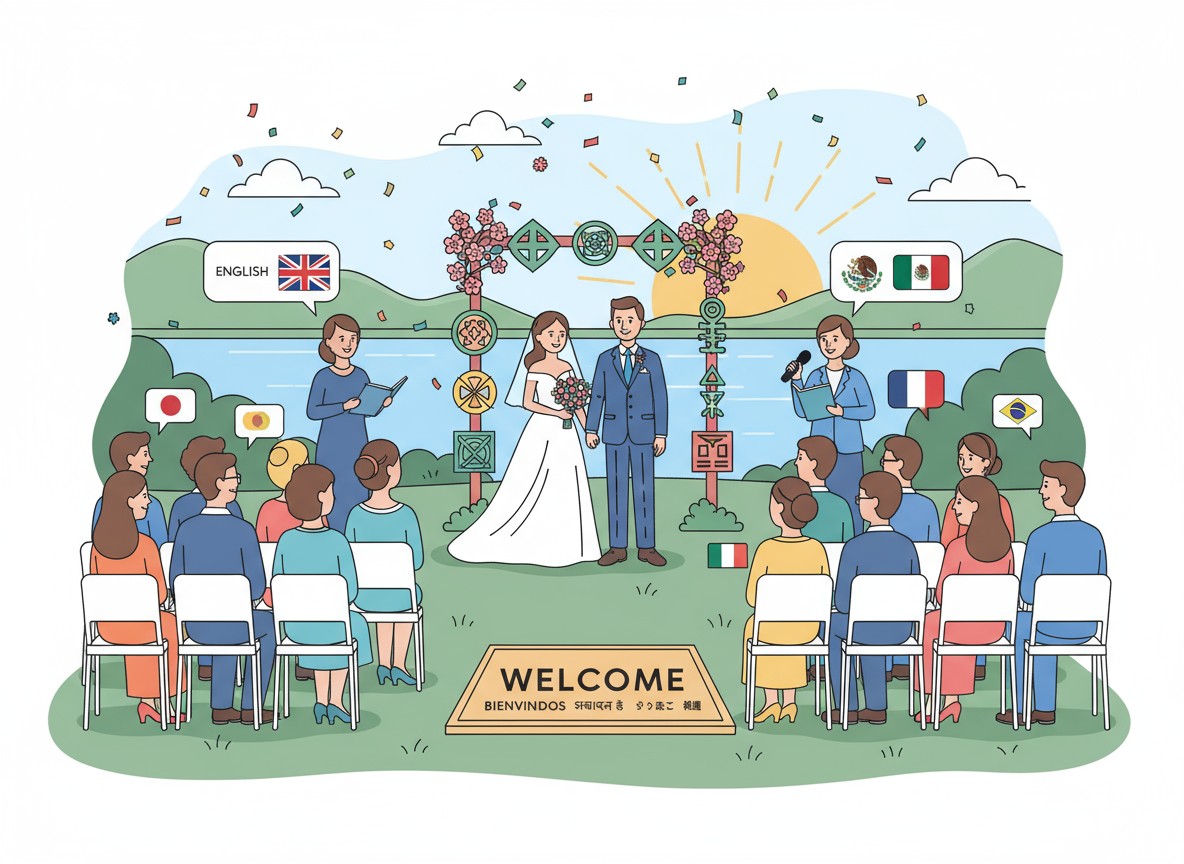
Your mother speaks only Mandarin, your partner’s grandmother speaks only Spanish, and half your friends are English-speaking Americans who took two years of high school French and remember nothing. Traditional wedding ceremonies conducted entirely in one language alienate portions of your guest list, leaving non-speakers sitting through incomprehensible rituals feeling disconnected from the celebration. Yet most couples planning multicultural weddings struggle to find resources addressing bilingual ceremony design, translation logistics, or cultural integration strategies that honor both backgrounds equally while ensuring no one feels like an outsider at your wedding.
Bilingual and multilingual weddings are increasingly common as globalization, immigration, and intercultural marriages create families speaking diverse languages. According to recent census data, over 21% of American households speak languages other than English at home, and many couples come from families where different generations or sides speak entirely different languages. These linguistic differences create unique wedding planning challenges—how do you design ceremonies where your Spanish-speaking grandmother and your partner’s Korean-speaking parents both feel included? How do you ensure meaningful participation when half the guests can’t understand the language being spoken?
This guide examines bilingual wedding planning from practical, cultural, and interpersonal perspectives. You’ll discover translation strategies, simultaneous interpretation techniques, bilingual ceremony script structures, program design for multilingual audiences, cultural tradition integration, and communication approaches that create inclusive environments where all guests feel valued regardless of their primary language. The strategies come from couples who’ve successfully navigated bilingual weddings, professional interpreters experienced in wedding contexts, and multicultural wedding planners specializing in language inclusion. Your wedding can genuinely welcome guests across language barriers rather than creating insiders and outsiders based on linguistic ability.
Assessing Your Specific Language Landscape
Before designing bilingual ceremony elements, map the actual language distribution among your guests. Create a spreadsheet listing each guest or family unit and their primary language, secondary languages they understand, and whether they need full translation assistance or just supplementary support. This audit reveals whether you’re dealing with a simple two-language situation (perhaps 60% English speakers and 40% Spanish speakers) or complex multilingual dynamics (English, Mandarin, Tagalog, Vietnamese, and Spanish speakers with no single common language).
Your language landscape determines which inclusion strategies are feasible. Two-language weddings can incorporate full parallel translation throughout ceremonies and receptions. Weddings with three to four languages might use primary translation for the most common language with written programs covering others. Events with five or more languages represented may need to choose a primary ceremony language with comprehensive printed translations and selective spoken elements in key languages. There’s no shame in not being able to accommodate every single language orally—logistical constraints exist, and guests generally understand this reality.
Identify which guests are most vulnerable to exclusion and prioritize their needs. Elderly grandparents who speak only their native language and have traveled internationally to attend deserve special consideration. Similarly, parents or close family members who’ve been deeply involved in your life but don’t speak the ceremony language need accommodation. Younger guests or distant relatives who are bilingual themselves may not require the same level of language support. Prioritization doesn’t mean excluding anyone—it means focusing efforts where they’ll have greatest impact.
Common Language Combinations at Multicultural Weddings
English-Spanish: Most common bilingual combination in the United States, often involving Mexican, Central American, South American, or Caribbean heritage families
English-Mandarin/Cantonese: Common with Chinese-American couples or families, often involving generational language differences
English-Tagalog: Filipino-American weddings frequently navigate these languages with additional regional dialects
English-Korean, English-Vietnamese, English-Hindi: Other frequent combinations reflecting diverse immigrant communities and multicultural marriages
Ceremony Script Strategies: Parallel Translation vs. Integrated Bilingual
Two primary approaches exist for bilingual ceremony scripts: parallel translation where everything is said in one language then repeated in another, or integrated bilingual scripts where languages alternate throughout the ceremony. Parallel translation ensures nothing is lost but roughly doubles ceremony length—a 20-minute ceremony becomes 40 minutes when fully translated. Integrated bilingual scripts maintain normal ceremony length but require more careful design to ensure equal representation and smooth flow between languages.
Parallel translation works best for formal ceremonies where accuracy and completeness matter most. The officiant speaks entire sections in one language, pauses, then a translator or second officiant repeats everything in the other language. This approach guarantees all guests hear complete ceremonies in languages they understand. The main drawback is length—guests must sit through repetition, and the rhythm of the ceremony is interrupted by translation pauses. To minimize these issues, keep the base ceremony concise so even with translation it remains under 30 minutes total.
Integrated bilingual scripts alternate languages more fluidly. Perhaps the welcome and opening remarks occur in English, the reading happens in Spanish, vows are exchanged with each partner using their preferred language, rings are blessed in both languages, and the closing happens in English again. This approach feels more dynamic and maintains energy better than straight parallel translation. However, it requires extremely detailed programs so everyone follows along in their language, and some ceremony elements inevitably receive less coverage in each language. Design integrated scripts so the most important moments—vows, ring exchange, pronouncement—happen in both languages while less critical elements can be in just one.
The Bilingual Officiant Advantage
Finding an officiant fluent in both your primary languages dramatically simplifies bilingual ceremony logistics. Bilingual officiants seamlessly move between languages, understand cultural nuances in both traditions, and create natural flow without awkward handoffs to translators. Many multicultural communities have clergy or celebrants specifically serving bilingual families—Chinese-American churches with Mandarin-English pastors, Catholic parishes with Spanish-English priests, or interfaith ministers fluent in multiple languages serving diverse communities.
If bilingual officiants aren’t available, consider co-officiation by two individuals each speaking different languages. A Spanish-speaking priest and an English-speaking minister can collaborate, each delivering portions of the ceremony in their language. This co-officiation signals equal respect for both languages and cultures while providing fluent delivery in each tongue. The officiants should meet multiple times before the wedding to coordinate timing, transitions, and ensure they present a unified message despite language differences.
Professional Interpretation Services
For complex multilingual weddings or when professional quality matters, hiring certified interpreters ensures accurate, smooth translation. Simultaneous interpretation—where interpreters translate in real-time through headsets worn by guests—provides the most sophisticated solution. Guests receive wireless headset receivers tuned to their language channel, allowing them to hear professional translation while ceremonies proceed normally in the primary language. This technology is common at international conferences and can be rented for weddings, though costs typically range from $1,500 to $4,000 depending on the number of languages and event duration.
Consecutive interpretation—where interpreters translate during pauses—costs less ($500-$1,200 for a ceremony) but extends event length significantly. The speaker talks for a minute or two, pauses for interpretation, continues speaking, pauses again. This stop-start rhythm disrupts ceremony flow but ensures accurate translation without expensive technology. Brief consecutive interpretation works better than lengthy simultaneous interpretation when you only need translation for key moments—perhaps just the vows, readings, and pronouncement—rather than entire ceremonies.
Whisper interpretation offers an informal middle ground. A bilingual family member or friend sits near non-speaking guests and whispers quiet translations throughout ceremonies. This works for small numbers of non-speaking guests (perhaps three to five elderly relatives) but becomes impractical for larger groups. The whisper interpreter must be genuinely fluent, able to translate quickly and accurately, and positioned close enough to assist their group without disturbing other guests. Some couples assign multiple whisper interpreters to different sections of seating, each helping nearby non-speakers.
Real Story: Mandarin-English-Spanish Wedding Success
Maria and Chen faced extraordinary linguistic complexity—her Mexican family spoke Spanish, his Chinese family spoke Mandarin, and their American friend group spoke English. Rather than attempting to accommodate all three languages orally, they chose English as the primary ceremony language with comprehensive printed programs in Spanish and Mandarin. Key ceremony moments—the welcome, vows, and pronouncement—were delivered in all three languages using parallel translation.
Their programs included complete ceremony scripts side-by-side in all three languages, cultural explanations in each language about traditions from the other cultures, and phonetic pronunciation guides so guests could follow along during the multilingual vow exchange. They hired a trilingual emcee for the reception who made announcements in rotating languages and incorporated music from all three cultures. Multiple family members told them it was the most inclusive multicultural wedding they’d attended—everyone felt welcomed despite the linguistic diversity.
Comprehensive Printed Programs as Essential Tools
Printed programs become absolutely critical at bilingual weddings, functioning as translation tools, cultural guides, and ceremony roadmaps. Create programs with complete ceremony scripts in all relevant languages arranged side-by-side in columns or in separate sections. Guests follow along in their language even when the spoken ceremony is in a language they don’t understand. This transforms passive confusion into active participation—guests read along, understand what’s happening, and feel included even when they can’t follow the auditory ceremony.
Programs should include more than just translation—add cultural explanations for traditions that may be unfamiliar to portions of your guest list. Explain the significance of the tea ceremony for guests unfamiliar with Chinese traditions, or describe the lasso ceremony for those who haven’t attended Mexican Catholic weddings. These educational notes help everyone appreciate the full meaning of your celebration rather than just observing unfamiliar rituals without context. Frame explanations respectfully: “In Chinese culture, the tea ceremony honors elders and symbolizes the couple’s gratitude to their families” rather than assuming ignorance.
Include phonetic pronunciation guides for names, locations, or important phrases in unfamiliar languages. If your ceremony involves guests responding in languages they don’t speak—perhaps “amen” or other ritual responses—provide phonetic spelling so everyone can participate vocally rather than sitting silently. Programs might also include key vocabulary translations: “Welcome – Bienvenido – 欢迎” or “Congratulations – Felicidades – 恭喜” giving guests tools to communicate basic sentiments across language barriers during social portions of your wedding.
Vows and Personal Statements: Intimate Bilingual Moments
Vows represent the ceremony’s emotional core and deserve special attention in bilingual weddings. Several approaches work well depending on your preferences and linguistic abilities. Some couples write vows in one language, then have them read aloud in both languages—you speak your English vows, then your partner’s bilingual cousin reads the Spanish translation, followed by your partner speaking their Spanish vows with translation into English. This ensures everyone hears complete vows in their language while maintaining the personal authenticity of you speaking your own words.
Other couples write and deliver vows in both languages themselves, demonstrating commitment to their partner’s linguistic heritage. You might say: “I promise to love you in both languages we speak, and in all the languages our hearts know—te prometo amarte en los dos idiomas que hablamos y en todos los idiomas que nuestros corazones conocen.” This bilingual vow delivery is deeply meaningful symbolically, representing your commitment to bridging cultures and languages throughout your marriage. It does require genuine bilingual ability though—poorly pronounced attempts at your partner’s language can feel more awkward than meaningful.
Some couples choose to deliver vows in their own native languages without translation, each speaking from the heart in the language most authentic to them. Include full translations in printed programs so everyone can read along and understand. This approach honors the reality that people express emotion most fully in their first language, and the untranslated delivery carries emotional authenticity even for those who don’t understand the words. Your partner hearing vows in your language, and you hearing theirs, creates intimacy that transcends translation anyway.
Music and Song Selections Crossing Language Barriers
Music transcends language barriers more easily than spoken words, making it an powerful tool for creating inclusive multicultural atmospheres. Incorporate music from both cultural backgrounds throughout your ceremony and reception—perhaps walking down the aisle to classical Western music but having the recessional feature traditional music from your partner’s culture. Reception playlists should alternate between cultural musical styles rather than dedicating the first hour to one culture and second hour to another. Interspersing different musical traditions creates unified celebration rather than segregated cultural blocks.
Consider instrumental versions of culturally significant songs that allow guests to appreciate melodies without requiring language comprehension. A beautiful instrumental arrangement of a traditional Chinese love song or a Spanish bolero communicates emotion and cultural connection without privileging one language group. Some couples commission musicians to create fusion arrangements combining musical elements from both cultures—perhaps a string quartet playing a traditional Mexican song in classical European arrangement, or a jazz band covering a Mandarin pop song.
If you include songs with lyrics, provide translations in programs. This works particularly well for ceremonial songs or meaningful selections where understanding the words enhances appreciation. When your ceremony features “Ave Maria” sung in Latin, printing English and Spanish translations lets all guests appreciate the lyrics’ meaning. Similarly, if your reception includes a Vietnamese song honoring elders, program translations help non-Vietnamese guests understand its significance. Music becomes a bridge rather than a barrier when you give people tools to understand it.
Reception Announcements and Emcee Responsibilities
Reception announcements—introducing the couple, explaining traditions, coordinating activities—need to reach all guests regardless of language. Hire a bilingual emcee who can deliver announcements in multiple languages, or have two emcees working together, each speaking a different language. Every major announcement should be delivered in all primary languages: “Ladies and gentlemen, please welcome the newlyweds” followed by “Damas y caballeros, por favor den la bienvenida a los recién casados.” This practice ensures no one misses important information about timing, activities, or logistics.
Visual cues supplement verbal announcements for guests who might miss them due to language or hearing limitations. Display slides or posters announcing activities: “Dinner will be served in 15 minutes – La cena se servirá en 15 minutos.” Digital displays, chalkboards, or printed signage placed prominently around your venue reduce reliance on auditory-only communication. Some couples use their wedding website’s event schedule feature, encouraging guests to check their phones for current activity information displayed in their chosen language.
Prepare your emcee with pronunciation guides for names in unfamiliar languages and cultural context for traditions they’re announcing. An emcee who mispronounces names or fumbles through cultural explanations creates discomfort rather than inclusion. Provide written scripts with phonetic spelling and brief cultural notes: “The Hora is a traditional Jewish circle dance celebrating the newlyweds [pronounced HOR-ah].” Your emcee should rehearse all announcements, practicing pronunciation and transitions between languages.
Common Translation Pitfalls to Avoid
Google Translate failures: Automated translation produces awkward, sometimes nonsensical results. Always have fluent speakers review translated materials before printing programs or posting signage.
Literal vs. cultural translation: Some phrases don’t translate literally. “Tying the knot” makes no sense in many languages. Work with cultural translators who can convey meaning rather than just words.
Assuming all Spanish speakers read Spanish: Language literacy varies. Some Spanish-speaking families include members who speak Spanish but read primarily in English or vice versa. Ask about reading preferences, don’t assume.
Forgetting regional variations: Spanish varies between Mexican, Puerto Rican, and Spanish dialects. Mandarin and Cantonese are different languages despite both being Chinese. Be specific about which variant you’re translating into.
Signage and Wayfinding in Multiple Languages
Venue navigation becomes challenging when guests can’t read directional signs. Create all signage in multiple languages—”Ceremony / Ceremonia,” “Restrooms / Baños,” “Reception Hall / Salón de Recepción,” “Quiet Room for Nursing Mothers / Sala Tranquila para Madres Lactantes.” This attention to multilingual wayfinding demonstrates that you’ve considered all guests’ needs, not just ceremony translation. Guests notice when couples make comprehensive efforts at inclusion versus superficial gestures.
Menu cards, escort cards, table numbers, and other printed reception materials should include all relevant languages. Escort cards might read “Please find your seat / Por favor encuentre su asiento” with guest names and table assignments. Buffet stations need multilingual labels—”Roasted Chicken with Herbs / Pollo Asado con Hierbas / 香草烤鸡.” This detailed translation helps guests with dietary restrictions, allergies, or religious food requirements identify safe options without needing to ask servers who may not speak their language.
Photo station signs, guest book instructions, hashtag information, and other interactive elements should explain instructions clearly in multiple languages. “Share your photos using #MariaAndChen2025 / Comparta sus fotos usando #MariaAndChen2025 / 使用 #MariaAndChen2025 分享您的照片” ensures everyone understands how to participate. Display these signs prominently with clear, readable fonts and avoid cramming too much text onto single signs—multiple clearly labeled signs work better than one overcrowded multilingual poster.
Toasts and Speeches: Managing Multilingual Participation
Wedding toasts and speeches present unique bilingual challenges—speakers naturally use their comfortable language, but this excludes guests who don’t understand. Establish clear expectations with anyone giving toasts about language inclusion. Request that speakers either deliver bilingual speeches or provide written translations for emcees to read after they speak. “I’ll give my toast in English, and then Carlos will read the Spanish translation” ensures everyone hears the message even if delivery time doubles.
Some speakers may genuinely be bilingual and capable of delivering speeches in multiple languages themselves. Encourage this when possible, but ensure they’re truly fluent enough for public speaking. Broken, heavily accented attempts at a language often cause more confusion than connection. If a speaker wants to include brief phrases in another language—perhaps thanking the in-laws in their native tongue—provide them with written pronunciation guides and cultural coaching so they can deliver those lines respectfully and accurately.
Limit total number of speeches to prevent the translated-speech portion of your reception from consuming hours. Three or four meaningful speeches in two languages might take 40-60 minutes with translation, which is already substantial reception time. If multiple family members want to speak, consider consolidating messages—perhaps one representative from each family delivers a collective toast rather than six individual speeches all requiring translation. Quality over quantity applies even more strongly at bilingual weddings where translation multiplies time requirements.
Cultural Traditions: Integration Without Tokenism
Incorporating cultural traditions from both backgrounds requires thoughtful integration to avoid superficial tokenism. Simply throwing in a tea ceremony or dollar dance without proper context or execution feels performative rather than authentic. Work with family members to understand the full meaning and proper performance of cultural traditions you’re including. The goal isn’t checking boxes (“we did something Chinese and something Mexican”) but genuinely honoring the cultural significance these traditions hold for your families and communities.
Introduce each cultural tradition before performing it, explaining significance in all languages. “We’ll now participate in the tea ceremony, a traditional Chinese custom where the couple serves tea to elders as a sign of respect and gratitude” followed by the Spanish equivalent helps unfamiliar guests appreciate what they’re witnessing. This educational moment transforms cultural traditions from mysterious exotic rituals into meaningful practices guests can appreciate even if they’re not from that culture. Consider having family elders speak briefly about traditions’ personal significance to them.
Balance cultural elements throughout your celebration rather than segregating them into separate sections. Alternate between cultural traditions so your event feels genuinely blended rather than two separate weddings awkwardly joined. Perhaps follow a Western ceremony processional with a Chinese tea ceremony, then later incorporate Mexican wedding lasso tradition during vow exchange, and include both cultural dances at the reception. This weaving creates a new multicultural tradition unique to your union rather than parallel presentations of separate cultural practices.
Children as Cultural and Linguistic Bridges
Many multicultural families include children who are naturally bilingual and can serve as informal translators and cultural bridges during weddings. Bilingual nieces, nephews, cousins, or younger siblings can help elderly relatives navigate the event, translate casual conversations, and facilitate connections between language groups. Don’t over-formalize these roles—children naturally mediate between generations and languages in multicultural families. Simply make sure they know they can help grandparents or other relatives if needed.
Including children in ceremony roles that highlight your multicultural identity creates beautiful symbolism. Perhaps children from both families participate in unity ceremonies, deliver readings in different languages, or serve as ring bearers and flower children wearing traditional attire from both cultures. These inclusions visually represent the blending of families and cultures while giving children meaningful participation. They also create memories that help younger generations appreciate and value their multicultural heritage.
Seating Strategies for Language Mixing
Strategic seating arrangements facilitate cross-cultural interaction while ensuring everyone has conversation partners in their language. Avoid segregating tables by language—”the Spanish table” and “the English table”—which creates separate celebrations within your wedding. Instead, seat bilingual guests at each table to serve as natural translators and conversation facilitators. This intentional mixing encourages interaction across language barriers while ensuring no one is stranded without anyone who speaks their language.
Balance language distribution thoughtfully—perhaps each table has 60% English speakers, 30% Spanish speakers, and 10% bilingual facilitators. Or mix three language groups across tables ensuring multiple speakers of each language at every table. This distribution allows same-language conversation subgroups while preventing complete linguistic isolation. Some guests will naturally form multilingual conversations using translation apps, gestures, or the few words they know in each other’s languages. These cross-language interactions create meaningful connections and memorable moments.
Consider assigning specific bilingual family members or friends as “table ambassadors” for tables with significant language diversity. These ambassadors help facilitate introductions, translate as needed, and ensure everyone at their table feels included in conversation. This role works particularly well for outgoing, naturally social people who enjoy bringing groups together. Brief them before the reception about who sits at their table and any cultural context that might help conversations flow smoothly.
Bilingual Wedding Planning Checklist
☐ Create guest list with primary and secondary languages for each person/family
☐ Decide on ceremony approach—parallel translation vs. integrated bilingual
☐ Find bilingual officiant or coordinate co-officiation by speakers of different languages
☐ Research professional interpretation services if needed (simultaneous or consecutive)
☐ Design comprehensive multilingual programs with complete ceremony scripts
☐ Include cultural explanations in all languages for traditions from each background
☐ Create phonetic pronunciation guides for names and key phrases
☐ Plan bilingual vow delivery or arrange for translations
☐ Select music representing both cultures with translations for songs with lyrics
☐ Hire bilingual emcee or coordinate dual emcees for reception announcements
☐ Create all signage in multiple languages—directions, menus, activity instructions
☐ Establish speech/toast protocols requiring translation or bilingual delivery
☐ Plan integrated cultural traditions with multilingual explanations
☐ Design seating arrangements mixing languages with bilingual facilitators at each table
☐ Have native speakers review all translations—never rely solely on automated translation
☐ Create visual schedule displays in multiple languages for reception timing
Digital Tools and Technology for Language Inclusion
Modern technology offers powerful tools for overcoming language barriers at weddings. Wedding websites can display content in multiple languages, either through automatic translation features or by creating separate pages for each language. Provide ceremony schedules, venue maps, travel information, accommodation recommendations, and other logistics in all relevant languages so guests can prepare appropriately regardless of their primary language. Some couples create video introductions in multiple languages welcoming guests and explaining what to expect from their multicultural celebration.
Translation apps like Google Translate have improved dramatically and can facilitate real-time conversation between guests speaking different languages. Include suggestions about translation apps on your wedding website: “We have guests speaking several languages. We encourage everyone to download Google Translate or similar apps to facilitate conversation across language barriers.” While these apps aren’t perfect, they enable basic communication and signal your encouragement of cross-cultural interaction rather than expecting everyone to struggle through language barriers alone.
QR codes on programs or table cards can link to digital content in multiple languages—perhaps videos explaining cultural traditions, audio recordings of readings in different languages, or detailed information about ceremony significance. Guests scan codes with their phones and access content in their preferred language instantly. This technological approach supplements printed materials without requiring 50-page programs covering every possible detail in every language. Some couples create dedicated wedding apps with language selection features giving guests personalized multilingual experiences.
The Deeper Meaning: Language as Bridge, Not Barrier
Bilingual wedding planning requires significantly more effort than monolingual celebrations. Everything takes longer—programs need multiple versions, ceremonies require coordination between languages, speeches need translation, and vendor communication becomes more complex when working across languages. This extra work feels overwhelming at times, and you might be tempted to just pick one language and ignore other speakers’ needs. Resist this temptation. The effort you invest in inclusive language planning directly demonstrates your values about family, culture, and respect for diversity.
Your bilingual wedding represents something profound—the coming together of different worlds, languages, and cultures into new family configurations. When elderly grandparents who speak no English hear their language spoken at your American wedding, they feel valued and included in ways that transcend simple translation. When your English-speaking friends learn cultural traditions from your partner’s heritage, they gain appreciation for diversity that extends beyond your wedding. When children see two languages and cultures honored equally, they learn that their multicultural identity is strength rather than confusion.
The bilingual, multicultural wedding you create establishes patterns for your married life. If you prioritize inclusive communication during wedding planning, you’re more likely to maintain that inclusivity as you navigate the ongoing challenges of multicultural family relationships. Your wedding becomes proof that different languages and cultures can coexist not just peacefully but beautifully, enriching everyone involved rather than creating division. This model serves your guests, your families, and eventually your own children who will inherit the multicultural identity you’re actively constructing through celebrations like this wedding.
Bilingual weddings challenge couples to think deeply about inclusion, representation, and how we create space for people different from ourselves. The easiest path involves choosing one dominant language and expecting everyone else to adapt. But ease isn’t the goal—meaningful celebration is. When you invest effort in comprehensive translation, cultural education, and thoughtful language integration, you create weddings where every guest truly feels welcomed regardless of their primary language. The elderly grandmother who only speaks Spanish sits through your ceremony understanding every word because you provided translation. Your partner’s Chinese parents hear their language honored alongside English throughout the celebration. Your friends from diverse backgrounds witness a model of respectful cultural integration rather than cultural dominance. These outcomes require planning, coordination, and investment of time and resources. But the alternative—weddings where portions of your guest list sit confused and excluded, unable to participate fully because they don’t speak the dominant language—is unacceptable when you’ve chosen to invite them to celebrate your union. Language barriers exist, but whether they function as walls or bridges depends entirely on the effort you make to translate, explain, and include. Your bilingual wedding can be the bridge that connects families, honors cultures, and demonstrates that love transcends language—but only if you do the work to make inclusion real rather than just aspirational. That work is worth it. Every single time.
Leave a Reply